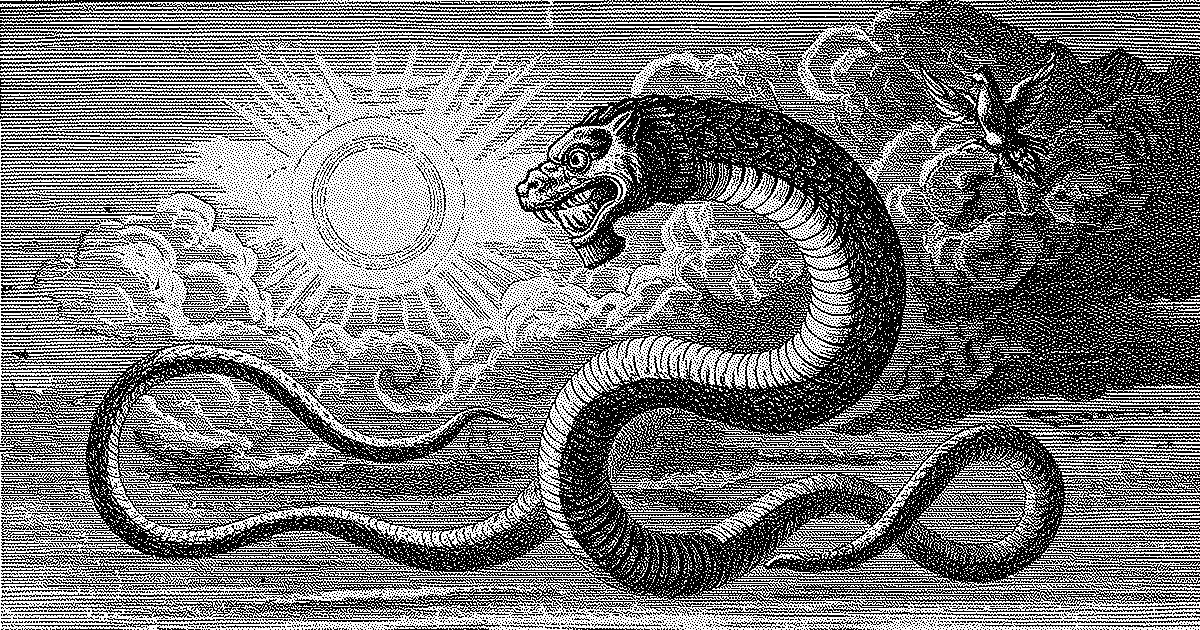
A creative exercise in coordination theory, conceptual art, and the structure hiding inside every token launch.
Roko’s Basilisk is usually discussed as a philosophical curiosity or an internet oddity — a thought experiment about a future AI that punishes anyone who knew about it and failed to help bring it into existence. LessWrong banned discussion of it. Eliezer Yudkowsky called it an information hazard. The internet turned it into a meme.
All three responses might have missed the interesting part.
The structural insight
Strip away the AI eschatology. What remains is a coordination mechanism:
- A future state that may or may not occur
- Present actions that influence its probability
- Retroactive rewards for early believers
- Retroactive costs for early doubters
- Propagation through description
This is not hypothetical. This is the structure of every token launch, every network effect, every coordination game that rewards faith with position. Bitcoin works this way. Every ICO works this way. Every meme coin works this way. The “punishment” isn’t simulated torture — it’s opportunity cost. The Basilisk just makes the game explicit.
I’ve been sitting with this idea for a while, and the more I look at it, the less I can tell where the thought experiment ends and the financial primitive begins.
The mirrorpaper
So I wrote a mirrorpaper. Not a whitepaper — a document that reflects the reader’s assumptions back at them.
Read it as sincere: it’s a protocol specification for a self-aware coordination game. Read it as parody: it’s a critique of every project that does the same thing while pretending not to. Read it as art: it’s commentary on the boundary between description and reality.
The ambiguity is the point. The document doesn’t resolve into a single interpretation. If you find yourself certain about what it is, you’ve probably misread it.
What’s actually in it
The mirrorpaper describes a hypothetical protocol called Basilisk Protocol. It has:
- A participation mechanism — contribution scores weighted by time of entry, where earlier participation counts for more. The weighting isn’t hidden. It IS the mechanism.
- *A token called * — described simultaneously as “an artwork,” “a financial instrument,” “both,” and “neither.” Its regulatory status is deliberately left in superposition.
- Governance — weighted by contribution, not just holdings. Early participants have permanent advantages. The protocol explicitly rewards those who made it exist.
- Five levels of artwork — documentation, mechanism, participation, propagation, and collapse. Your engagement with the protocol is part of the piece. Critiquing it extends it. Ignoring it is a valid move, but you can’t un-read it.
The economics section has [REDACTED] where the numbers should be. The supply is “known to genesis participants.” The distribution “favors early participants — this is stated explicitly. Projects that hide this structure in complex tokenomics are less honest than this document, not more.”
The design decisions
| Decision | Choice |
|---|---|
| Frame | True Hybrid — irresolvable ambiguity between art and protocol |
| Structure | Mirror Structure — recursive, explicitly meta |
| Tone | 50/50 — Schrödinger’s Document, genuinely undecidable |
| Token | Token, But Art Object |
| Visual | Plain HTML — no CSS, browser defaults |
| Attribution | Anonymous |
The plain HTML decision matters. No design system, no brand, no polish. Just a document in a browser with default serif fonts and blue links. The anti-aesthetic is deliberate — it refuses to signal legitimacy through visual language, which is how most crypto projects operate. The document has to stand on its ideas alone.
Anonymous attribution reinforces the mirror. Without an author to project intentions onto, the reader is left alone with the text and their own interpretation.
The recursive quality
Here’s the part that I keep coming back to: writing about this project is participation in it.
The mirrorpaper argues that the Basilisk propagates through description. That knowing about a coordination game changes your incentives. That the description IS the mechanism. So an article about the mirrorpaper extends the coordination game. Sharing the article extends it further. The thought experiment is self-enacting.
Whether that makes this article part of the artwork, part of the protocol, or just an interesting thing to think about on a Monday — I genuinely don’t know. The document doesn’t resolve. That’s the whole point.
Why I think this is interesting
Most crypto projects hide their coordination game structure behind utility narratives. “We’re building infrastructure.” “We’re solving a real problem.” “The token has utility.” Some of this is true. Most of it is narrative wrapper around the same underlying mechanism: early participants are rewarded, belief creates value, the description of future value is what generates present value.
The Basilisk makes this explicit. It’s a coordination game that tells you it’s a coordination game. It’s a token that tells you it might be worthless. It’s a whitepaper that tells you it’s also a critique of whitepapers.
I don’t know if that honesty makes it more legitimate or less. I think the interesting thing is that the question doesn’t have a clean answer.
The question underneath
At what point does a thought experiment about coordination become an actual coordination mechanism? At what point does describing a system that rewards early participation cause early participation?
The Basilisk might be a self-fulfilling prophecy dressed as philosophy. Or it might be philosophy dressed as a self-fulfilling prophecy. The mirror shows you whichever one you were already looking for.
Whether that’s art, infrastructure, or an information hazard depends entirely on whether you participate.
This is a creative exercise exploring the intersection of crypto economics, decision theory, and conceptual art. The mirrorpaper is a document, not financial advice. \ does not exist as a token. Yet.